Jun 12, 2009

Paper stockbook

One of my hobbies is collecting papers such as ephemera, tickets, foreign newspapers or something like that.
I used to stock them in boxes and drawers, but they have been increasing...
So I made a paper stockbook by myself to organize some of them.

You can make it easily by holing papers and sewing holes with a needle and hemp thread.
In addition, I sewed an iron button and a length of thin ribbon on the front cover so that I can tie up the book.

Tickets are in small glassine bags

French buvard and old match labels

Sometimes my friends give me some fancy papers

I love airplane logos!

This is the back cover

Making books is easy and fun!
I would like to make some another books soon.

Jun 11, 2009

Vintage ironing board

I think that the housework I am best at is ironing.
I have heard that ironing is the most unpopular housework among housewives, but I have been ironing since I was a child and I am unbothered by it.
Therefore I use an iron and ironing board very much.


One day my husband found this ironing board at an antique shop and we decided to buy it.
I love this wooden rustic one!
I have been leaving it in the living room, but it fits well with any other furniture.

Jun 10, 2009

Takeshi Omura's tea pot

I received this small tea pot from my mother as a birthday present.

It was made by one of young Japanese potters, Takeshi Omura.
The height is about 4"(10cm).
It looks like rusty iron, but it is a ceramic work.

The very thin, delicate lid is also nice.
You can serve two or three cups of Japanese tea with this.

Jun 9, 2009

Nanbu iron bottle opener

These are bottle openers made of Nanbu iron(cast iron).

Nanbu ironware is one of the most famous Japanese traditional ironware, and it is famous for "Nanbu iron bottle(pot)".

These bottle openers were made by Nobuho Miya, who has been receiving some awards at home and abroad.

Jun 8, 2009

At a garage sale

Garage sale is common in the U.S., but in Japan, it's not.
These are the items that I found at the garage sale where I went for the first time in life.

I was so surprised that all items were so cheap!
This is the vintage fondue set of DANSK, and it costs over $200 if you buy the same one in Japan, but I could get this in only $1!!!

These small pots are of MIKASA, which is originally a Japanese ceramic maker, but it is also familiar in the U.S.
I don't know the period they were made, but they look like Scandinavian pottery around 1960s -70s.
They were also $1 in two pieces.

Finding bargains is so fun!!!

Jun 7, 2009

Karlskrona cup & saucer

I sometimes visit Antique Mall near my place.
It is my new hobby after coming to the U.S.
I rarely find Scandinavian items at American antique shops, but I came across this cup & saucer made from Sweden.

Its pottery is Karlskrona.
I have heard of this name, but I hadn't had this pottery's products before buying this one.


I love this plain hand-painted design!

Jun 6, 2009

Wooden butter knives

I am Japanese and I eat rice much more often than bread.
It is still the same after coming to the U.S.

But I had been thinking that I would eat bread more often in the U.S. and I bought some butter knives before leaving Japan.

They were made by Tsutomu Suzuki, who is a woodworking craftsman.
He usually makes wooden furniture, but sometimes makes this kind of small items.
I came across them in a small pottery shop in Osaka(Japan).

Their shapes are different from each of the knives, the surface of them is very smooth and they are easy-to-use.


However, I use them only when guests come over because my husband and I rarely eat bread at home...

Jun 5, 2009

SELETTI pitcher & salt/pepper pots

I bought them when I visited Geneva last October.

This cute pitcher is made of SELETTI, which is an Italian company mainly offers interior decoration related products.
The size of this pitcher is almost as same as a 500ml milk carton, and it looks just alike real milk!

These are SELETTI's products as well.
They look like cans, but they are salt & pepper pots.
You can set salt and pepper in a pot from the bottom side.

SELETTI has some other cool products.

Jun 4, 2009

"Bizen ware" beer mugs

Bizen ware(Bizen-yaki) is one of the most famous Japanese potteries and it is characterized by ironlike hardness, reddish brown color and absence of glaze.

These are Bizen beer mugs.
My cousin who lives near Bizen(Okayama prefecture) gave me them before my leaving Japan.

It has been said that Bizen ware makes sake(alcohol) delicious and you become less likely to get a hangover if you drink sake with Bizen ware.
Therefore many famous Japanese restaurants have been using them regularly.

Jun 3, 2009

Stig Lindberg "BERSA" plates

These plates inspired me to start to collect Scandinavian vintage ceramics.
I think I don't have to explain this pattern since it's so famous...

The name of this pattern is "BERSA", designed by Stig Lindberg who was a Swedish ceramic designer, painter and illustrator.

I think that this pattern was designed to fit every food.
This was designed in 1960s, but it is still tasteful.

After getting these plates, I have bought several items for this pattern.
I am using them almost daily.

Jun 2, 2009

Cafe Taraso

One of my hobbies is visiting cafes.
When I lived in Japan, I visited a lot of nice cafes in Kobe, Osaka, Kyoto and Tokyo.

This cafe is one of my favorite, but it is far from my town Kobe, so it is only once that I have been there.

Its name is "Taraso".
This cafe is in the very south of Aichi prefecture, very rural place, and which is on the Mikawa bay.
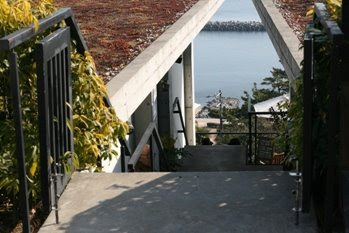
Walking down these stairs, the cafe appears.

You can see the very beautiful scenery from the deck.
It is so very quiet and the climate is pretty moderate.

I ate this honey butter toast as breakfast and it was so nice!

It made me feel so luxurious.
I want to visit there soon!

Jun 1, 2009

Cup & saucer for Japanese tea

When we have Japanese tea, usually use this kind of cup & saucer without handle.

I got them at the department store in Osaka(Japan), and I don't know the company/brand name of them.

They are handcrafted, so they have slightly different grain patterns of each.

I like Japanese modern stuffs like this.